
Is Solar still profitability after new net billing Pakistan 2026
Introduction
Pakistan’s solar industry has entered a new phase in 2026.
Table of Contents
ToggleWith the implementation of the NEPRA Prosumer Regulations 2026, the country officially transitioned from the traditional Net Metering framework to a revised Net Billing Policy. This change has raised one major concern among homeowners, businesses, and factory owners:
Is solar profitability after net billing Pakistan 2026 still realistic?
The short answer is:
✅ Yes — solar remains profitable.
But the strategy behind installation has changed.
In this detailed guide, we will break down:
-
What changed under the new Net Billing Policy Pakistan 2026
-
Updated solar ROI Pakistan 2026
-
Real financial comparisons
-
Who is affected most
-
How to maintain strong returns
-
Whether installing solar in 2026 is still worth it
Let’s analyze this properly.
See NEPRA Prosumer Regulations 2026 in the video below by MFES Solar Energy
What Changed Under the New Net Billing Policy in Pakistan (2026)?
Under the previous Net Metering Regulations 2015, exported electricity was adjusted against imported electricity on a unit-for-unit basis.
If you exported 400 units and imported 400 units:
Your energy charge was nearly zero.
That system encouraged aggressive system sizing and maximum export.
But in 2026, under the NEPRA Prosumer Regulations 2026, the financial structure changed completely.
Now:
-
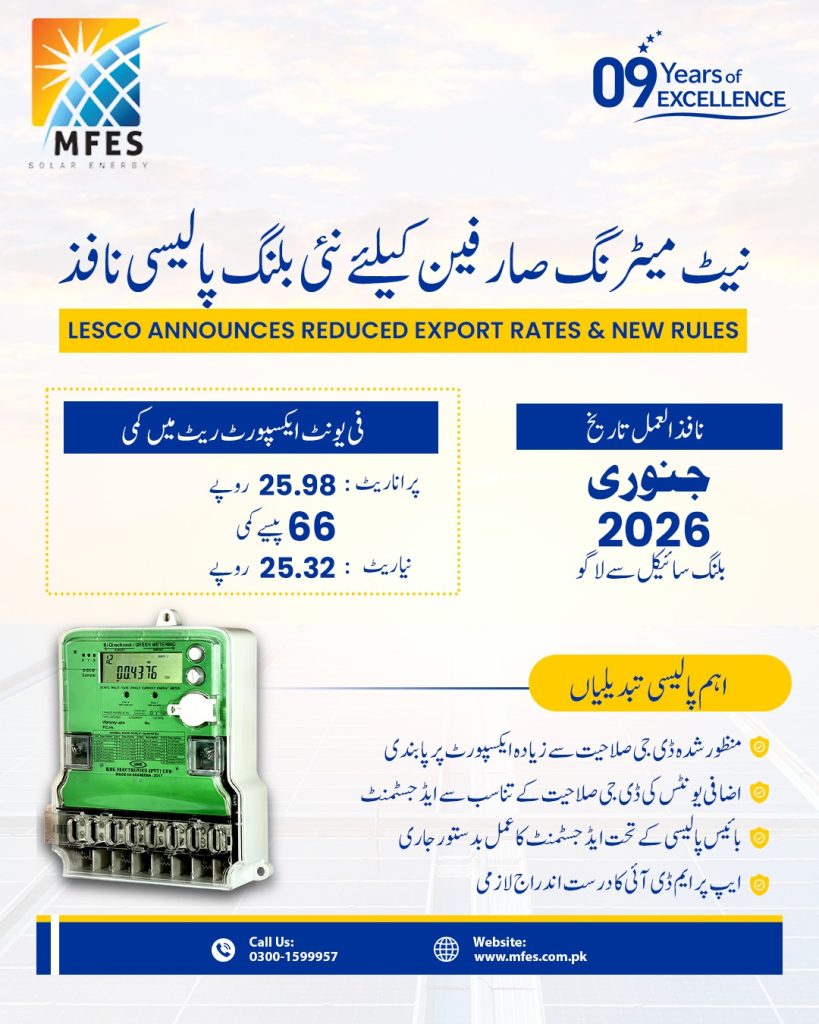
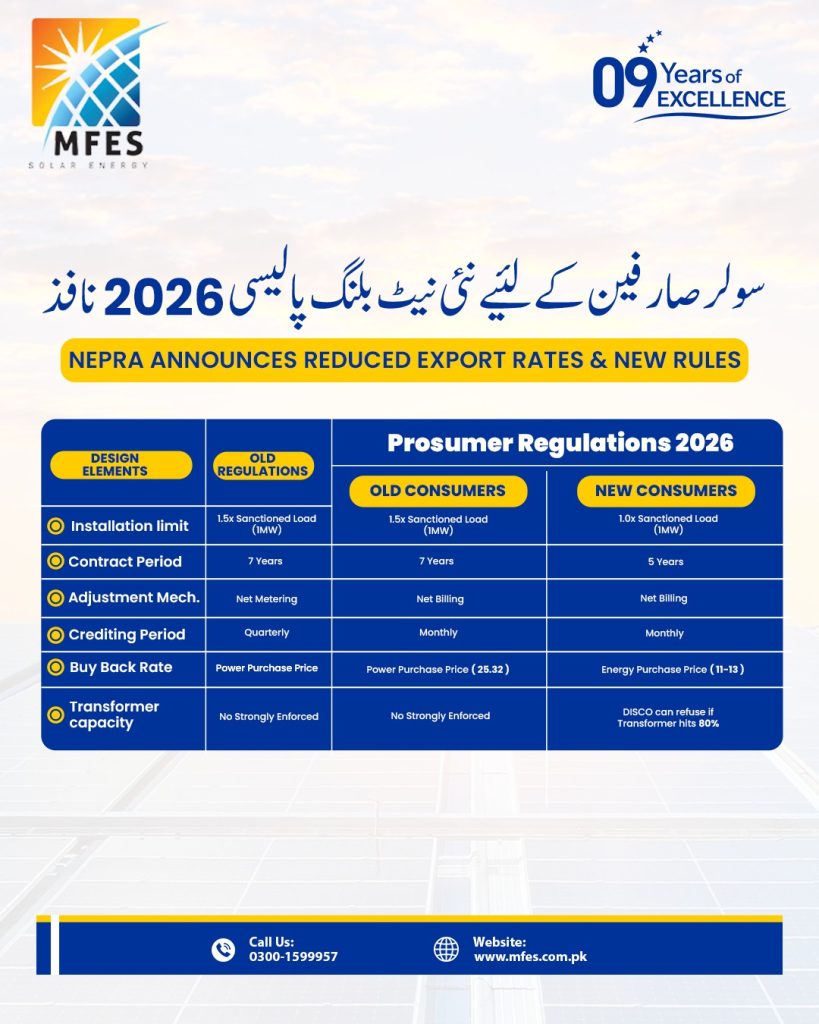
Exported electricity is purchased at approximately Rs. 11 per unit
-
Imported electricity is billed at full retail tariff (often Rs. 40–65 per unit)
-
New agreements are limited to 5 years (previously 7 years)
This creates a major pricing gap between:
-
What you sell to the grid
-
What you buy from the grid
And that gap directly affects solar payback period 2026 calculations.
NEPRA Prosumer Regulations 2026 – Understanding the New Net Billing Policy vs the Old Net Metering Policy
Financial Comparison: Old Net Metering vs New Net Billing
Let’s look at a practical example.
Assume:
-
Retail tariff = Rs. 55 per unit
-
Export rate = Rs. 11 per unit
-
Monthly import = 600 units
-
Monthly export = 400 units
Under Old Net Metering
Net units = 600 – 400 = 200
Bill = 200 × 55 = Rs. 11,000
Under Net Billing (2026)
Import cost = 600 × 55 = Rs. 33,000
Export credit = 400 × 11 = Rs. 4,400
Final bill = Rs. 28,600
Yes, the difference is significant.
This is why many people believe solar profitability after net billing Pakistan 2026 has disappeared.
But that conclusion is incomplete.
Has Solar Stopped Being Profitable in Pakistan?
No.
The profitability model has shifted from:
❌ Maximum export
to
✅ Maximum self-consumption
Earlier, oversizing systems worked because export rates were attractive.
Now, financial success depends on:
-
Using solar electricity directly during daytime
-
Matching system size with real consumption
-
Reducing peak-hour grid dependency
-
Integrating storage solutions where necessary
Solar has evolved from a “zero bill” tool to an energy cost management strategy.
Updated Solar ROI Pakistan 2026
Before 2026:
Average payback period: 2.5–3 years
After net billing:
Estimated payback period: 4.5–5 years
Yes, the ROI timeline has nearly doubled.
But consider this:
-
Grid tariffs continue increasing annually
-
Fuel adjustment charges are unpredictable
-
Inflation affects energy pricing
-
Capacity charges remain embedded in bills
A 4–5 year payback for an asset that lasts 20–25 years is still financially strong.
For commercial and industrial users, ROI can still remain competitive if the system is designed intelligently.
Who Is Most Affected by the New Net Billing Policy?
1️⃣ New Solar Applicants (After February 2026)
-
Fully under Net Billing Policy Pakistan 2026
-
Export valued around Rs. 11 per unit
-
5-year agreement structure
2️⃣ Existing Net Metering Users
-
Original agreement remains protected
-
Usually 7-year contract
-
Continue receiving previous export valuation until expiry
After agreement renewal, new benchmark pricing may apply.
Net Metering in Pakistan (2025–2026): Updated Rules, Process, Billing & NEPRA Policy
How to Maintain Strong Solar Profitability in 2026
To maintain strong solar ROI Pakistan 2026, strategy matters more than ever.
✅ 1. Right-Size the System
Oversizing purely for export is no longer viable.
Instead:
-
Conduct load analysis
-
Evaluate daytime consumption
-
Match system capacity to internal demand
Especially for factories and commercial buildings operating during daylight hours.
✅ 2. Increase Self-Consumption
Use heavy loads during solar production hours:
-
Air conditioners
-
Industrial machinery
-
Water pumps
-
Production equipment
Every unit consumed directly saves Rs. 55 instead of selling at Rs. 11.
That’s a massive financial difference.
✅ 3. Hybrid Solar System Pakistan Trend
Under the new framework, Hybrid Solar System Pakistan demand is increasing.
Why?
Instead of exporting at low rates:
-
Store excess electricity
-
Use during evening peak hours
-
Avoid expensive grid tariffs
Battery storage is becoming financially smarter under net billing.
✅ 4. Focus on Energy Efficiency
Solar in 2026 is about:
-
Demand management
-
Peak load reduction
-
Consumption optimization
-
Smart inverter configuration
It’s financial engineering — not just panel installation.

Is Solar Still a Smart Investment in Pakistan?
-
If you:
-
Have high monthly electricity bills
-
Operate during daytime hours
-
Plan long-term property ownership
-
Want protection from tariff hikes
Then yes — solar remains a smart long-term investment.
Even under solar profitability after net billing Pakistan 2026, you can still reduce 50–70% of your electricity cost.
For industrial clients, benefits include:
-
Operational stability
-
Predictable budgeting
-
Reduced exposure to tariff volatility
-
Improved sustainability credentials
-
Why Proper Engineering Matters More in 2026
Under the new structure, mistakes can destroy ROI:
❌ Oversized system
❌ Poor load study
❌ Wrong inverter selection
❌ Ignoring transformer limitations
❌ Ignoring DISCO compliance
This is why professional planning is critical.
Import cost = 600 × 55 = Rs. 33,000
Export credit = 400 × 25.32 = Rs. 10,128
Final bill = Rs. 22,872
How MFES Solar Energy Ensures Profitability Under Net Billing
At MFES Solar Energy, we understand that 2026 is not the end of solar — it’s the beginning of smarter solar.
Based in Lahore and serving commercial, industrial, and agricultural clients across Pakistan, we provide:
-
Detailed load analysis
-
Net Billing–compliant system design
-
Hybrid and battery integration
-
Accurate ROI forecasting
-
Professional installation
-
After-sales technical support
We don’t promise “zero bills.”
We deliver:
✔ Controlled energy cost
✔ Financial clarity
✔ Long-term stability
✔ Realistic projections
Our goal is to ensure that solar profitability after net billing Pakistan 2026 remains achievable for our clients.
Frequently Asked Questions (FAQ)
Is Solar still profitability after new net billing Pakistan 2026?
Yes. Although export rates have dropped to approximately Rs. 11 per unit under the Net Billing Policy, solar still offers 4.5–5 year ROI and long-term tariff protection.
What is the export rate under the new net billing policy?
Exported electricity is valued at approximately Rs. 11 per unit for new installations under the NEPRA Prosumer Regulations 2026.
What is the difference between net metering and net billing?
Net metering adjusted exported and imported units one-to-one. Net billing treats them as separate financial transactions with different buy and sell rates.
Should I install a hybrid system in 2026?
Yes, hybrid systems are becoming more attractive because storing electricity for later use is more valuable than exporting at low rates.
Is solar still good for factories and businesses?
Yes. Commercial and industrial users with high daytime consumption can still achieve strong ROI through optimized system design.
The more you export, the less financial advantage compared to the old system.
Therefore, value shifts toward:
✔ using solar power directly
✔ minimizing surplus
✔ aligning generation with demand
Final Verdict: Solar in 2026 Is About Strategy, Not Hype
The era of easy unit swapping is over.
But solar is far from dead.
Instead of chasing export revenue, successful investors will focus on:
-
Smart system sizing
-
Self-consumption
-
Hybrid integration
-
Long-term financial planning
If engineered correctly, solar profitability after net billing Pakistan 2026 is still achievable — especially for informed buyers.
📞 Ready to Evaluate Your Solar ROI Under the New Policy?
If you want:
-
Accurate ROI calculation
-
Net Billing–compliant design
-
Commercial or industrial consultation
-
Hybrid system planning
Contact MFES Solar Energy today.
Let’s design a system that works for 2026 — and beyond.
Contact MFES Solar Energy
https://mfes.com.pk/ Plot 188, Opposite Expo Center Gate #3, Johar Town, Lahore
 0300-1599957 | 0314-3072721 | 042-31357272
 www.mfes.com.pk
 info@mfes.com.pk
 facebook.com/MultifunctionalEngineeringSolutions
MFES Solar Energy