
NEPRA Prosumer Regulations 2026 – Understanding the New Net Billing Policy vs the Old Net Metering Policy
Introduction
Pakistan’s distributed solar market has entered a transformative phase.
Table of Contents
ToggleFor nearly a decade, consumers installing rooftop solar operated under the Net Metering Regulations 2015, a framework that allowed electricity to be exchanged with the grid on a unit-to-unit basis. The rule was simple: export a unit during the day, take a unit back later.
In 2026, the introduction of the NEPRA Prosumer Regulations replaced that arrangement with a new structure known as Net Billing.
This is more than a policy tweak.
It fundamentally changes how savings are calculated, how systems should be sized, and how investors must think about payback.
In this article, we break it down in plain, practical language.
We will cover:
✔ what the old model was
✔ what the new model introduces
✔ rates now applicable
✔ how existing users are treated
✔ real bill comparisons
✔ what strategies will win in this new environment
See NEPRA Prosumer Regulations 2026 in the video below by MFES Solar Energy
The Philosophical Shift – Swap vs Trade
The core transformation is this:
Old system → electricity swap
New system → electricity trade
Earlier, energy exported offset energy imported.
Now, electricity exported is sold, and electricity imported is purchased.
Money becomes the basis instead of units.
⚡ Recap – How Net Metering Worked Before
Under the previous regime:
- Import and export were measured in kilowatt-hours.
- Export reduced import.
- Surplus could be carried forward.
Example:
Export 400 units in sunlight hours.
Import 400 units at night.
Energy charge → nearly zero.
Because of this simplicity, many people sized plants aggressively, often targeting maximum exports.
💰 What Is Net Billing in 2026?
https://mfes.com.pk/difference-between-dg-capacity-and-export-mdi/Under the new regulations, two independent financial transactions occur.
When you draw electricity from DISCO:
You pay the retail consumer tariff (which in many cases exceeds Rs. 50–60 per unit after taxes).
When you send electricity to DISCO:
They purchase it at a national benchmark rate.
Not your retail rate.
Not your slab rate.
A separate, standardized purchase price.
Difference Between DG Capacity and Export MDI
Two Numbers Every Prosumer Must Know
During the remaining term of existing agreements:
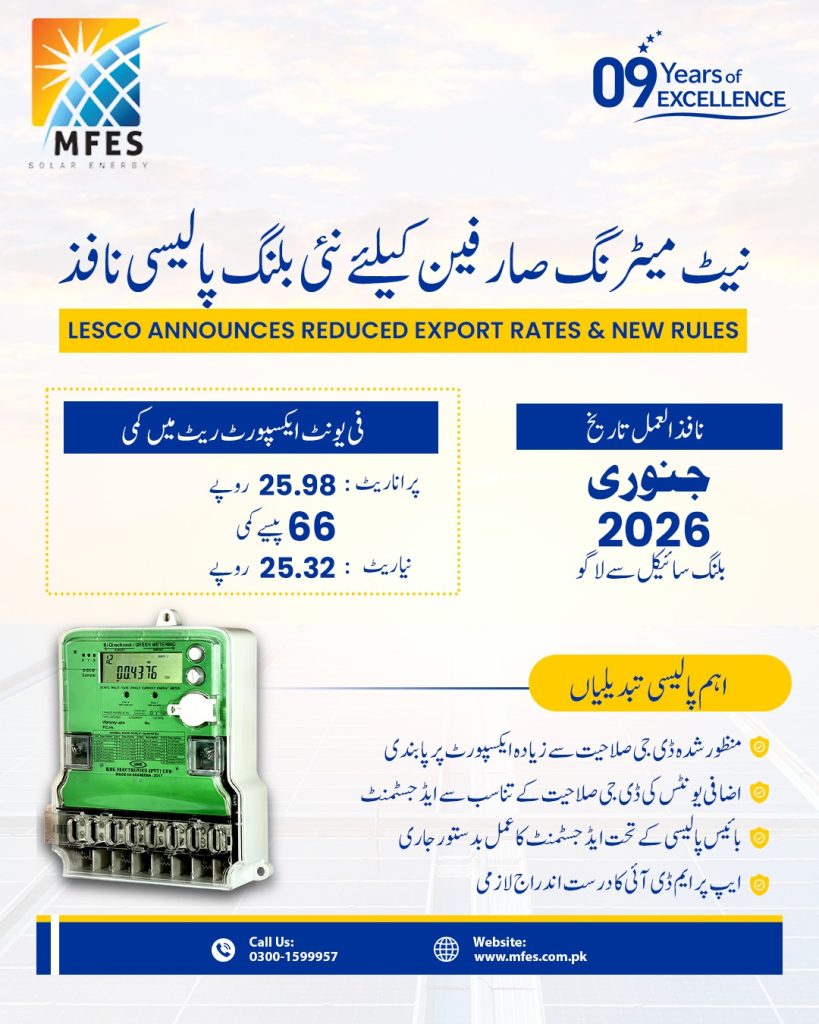
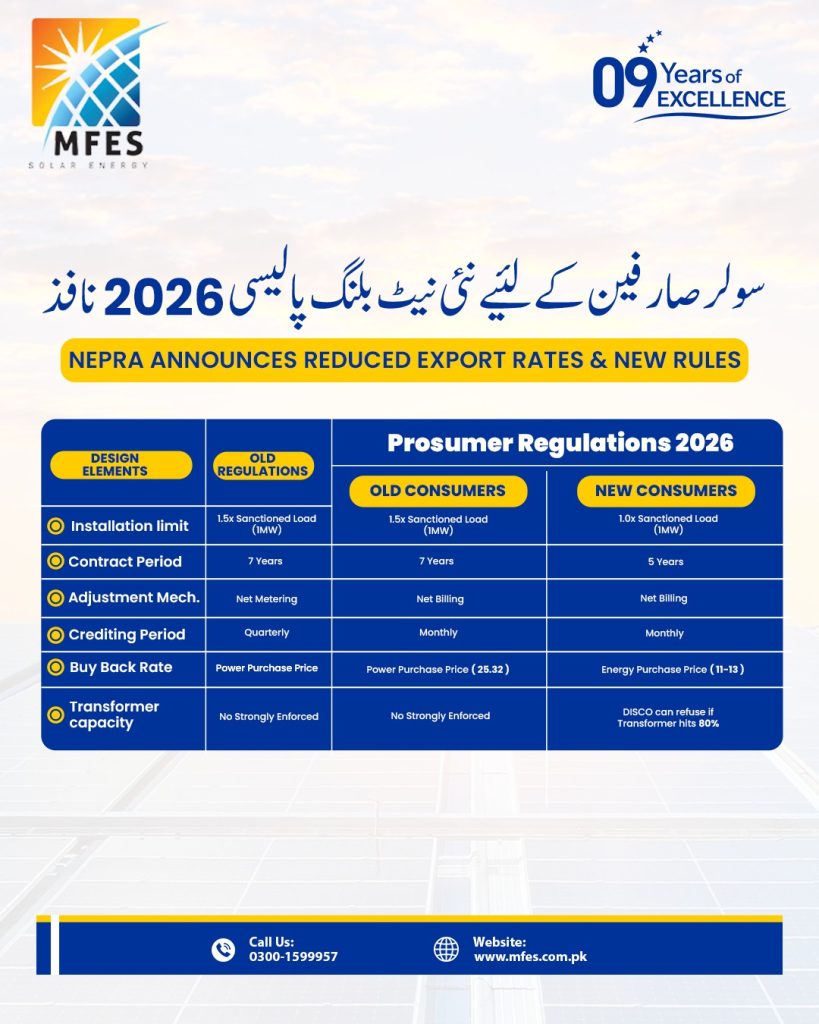
Export compensation = National Average Power Purchase Price (NAPPP)
👉 currently around Rs. 25.32 per unit.
After agreement expiry or for renewals:
Export compensation = National Average Energy Purchase Price (NAEPP)
👉 approximately Rs. 11 per unit.
This difference is central to future economics.
The New Reality in One Sentence
You may buy electricity at Rs. 55
but sell it at Rs. 25 or even Rs. 11.
Bill Comparison – Old vs New
Let’s assume:
- Import = 600 units
- Export = 400 units
- Retail tariff = Rs. 55
Old Net Metering
Net units = 600 – 400 = 200
Bill = 200 × 55 = Rs. 11,000
Net Billing with NAPPP = 25.32
Import cost = 600 × 55 = Rs. 33,000
Export credit = 400 × 25.32 = Rs. 10,128
Final bill = Rs. 22,872
Net Billing with NAEPP ≈ 11
Export credit = 400 × 11 = Rs. 4,400
Final bill = Rs. 28,600
What Does This Teach Us?
The more you export, the less financial advantage compared to the old system.
Therefore, value shifts toward:
✔ using solar power directly
✔ minimizing surplus
✔ aligning generation with demand
What Happens to Existing Solar Owners?
This is where confusion exists.
The regulation protects:
✔ validity of licence
✔ continuity of system
✔ right to remain connected
But billing will transition to the new structure.
Transitional Arrangement
Until expiry of your current agreement → export valued at Rs. 25.32.
After renewal → future benchmark (around Rs. 11) may apply.
So while protection exists, the settlement method becomes monetary.
Why Governments Move Toward Net Billing
Pakistan is not alone.
Many countries transitioned from net metering to net billing when:
- rooftop solar penetration increased
- utilities faced revenue imbalance
- cross-subsidies grew
- infrastructure stress appeared
Net billing tries to reflect actual energy procurement cost instead of retail pricing.
New Limitation on System Size
Under the updated framework:
👉 installed DG capacity cannot exceed sanctioned load.
This discourages plants built primarily to export large volumes.
Design will now focus on internal usage.
Agreement Duration
Standard term = 5 years, extendable with mutual consent.
Future pricing flexibility is therefore built into the structure.
Transformer Utilization Rule
If transformer loading reaches around 80%, DISCO may refuse additional interconnections.
This makes early planning important.
For Commercial & Industrial Installations
Projects 250 kW or larger require load flow studies.
Expect higher documentation, engineering validation, and timelines.
Will Solar Still Provide Returns?
Yes, but returns become smarter rather than automatic.
Solar continues to hedge against:
✔ rising tariffs
✔ unpredictable fuel adjustments
✔ currency-driven cost spikes
✔ long-term inflation
The difference is that optimization now matters more.
Strategy for Success in the Prosumer Era
Winning projects will emphasize:
✅ consumption during sunlight hours
✅ machinery scheduling
✅ energy efficiency
✅ demand management
✅ optional storage integration
Future profitability = intelligent usage.
What Responsible Installers Must Tell Clients
The market narrative must evolve from:
“Your bill will vanish”
to
“Your energy cost will become controlled and predictable.”
Transparency builds long-term trust.
Winning projects will emphasize:
✅ consumption during sunlight hours
✅ machinery scheduling
✅ energy efficiency
✅ demand management
✅ optional storage integration
Future profitability = intelligent usage.
Mistakes New Buyers Should Avoid
❌ Installing bigger systems without load study
❌ Expecting old style payback
❌ Ignoring usage pattern
❌ depending purely on export revenue
Solar remains powerful — but planning must mature.
Final Perspective
The Prosumer Regulations 2026 do not shut down solar growth.
They push the industry toward efficiency, realism, and financial clarity.
The age of easy unit swapping is over.
The age of strategic energy management has begun.
Consumers who understand this transition will still achieve strong, sustainable benefits.
Contact MFES Solar Energy
https://mfes.com.pk/ Plot 188, Opposite Expo Center Gate #3, Johar Town, Lahore
 0300-1599957 | 0314-3072721 | 042-31357272
 www.mfes.com.pk
 info@mfes.com.pk
 facebook.com/MultifunctionalEngineeringSolutions
MFES Solar Energy