
Lithium-Ion Solar Battery Lifespan: How DoD, C-Rate & Temperature Affect Battery Life?
Quick answer: A lithium solar battery usually lasts longer when it avoids unnecessarily deep discharges, excessive charging or discharging currents, and prolonged heat. However, the safest settings and expected cycle life depend on the battery chemistry, its exact model, battery management system (BMS), and manufacturer specifications.
A lithium battery is often the most expensive component added to a hybrid solar system. That makes one question especially important for homeowners in Lahore and across Pakistan: how can you protect the battery so it delivers reliable backup for years?
Three technical terms explain much of the answer: Depth of Discharge (DoD), C-rate, and operating temperature. Understanding them can help you compare battery quotations, size your storage correctly, and avoid settings that place unnecessary stress on the system.
What determines lithium solar battery lifespan?
Battery lifespan is measured in two complementary ways. Cycle life is the number of charge/discharge cycles a battery can complete before falling to a stated remaining-capacity threshold, often 80%. Calendar life describes capacity loss as the battery ages with time, even if it is rarely used. Heat, time spent at high charge levels, and cycling conditions all influence the outcome.
Also note that “lithium-ion” is a family of battery chemistries. Lithium iron phosphate (LiFePO4 or LFP), widely used in residential solar storage, is a type of lithium-ion chemistry. It should not be assumed to have identical cycle life or temperature behavior to other lithium-ion chemistries such as NMC.
1. What is DoD (Depth of Discharge) in a lithium battery?
Depth of Discharge tells you how much of a battery’s rated capacity has been used. State of Charge (SoC) tells you how much remains. In simple terms, DoD = 100% − SoC, provided both use the same reference capacity and the battery’s displayed percentages are calibrated accordingly.
Example: If a 10 kWh battery starts at 100% SoC and is discharged to 20% SoC, its DoD is 80%. It has delivered about 8 kWh of nominal DC energy before allowing for operating limits and conversion losses. A battery used from 100% to 50% SoC has experienced 50% DoD.
Deeper discharge generally means more cycling stress. The key point is not that an 80% DoD is automatically harmful: many modern LFP batteries are designed and warranted for deep cycling. The right daily discharge limit depends on the specific product, available solar generation, and required backup reserve.
How does DoD affect cycle life?
A useful real-world reference is the Victron Lithium NG 51.2 V / 100 Ah LFP battery. Its published cycle-life figures, measured to at least 80% remaining capacity, are shown below. These numbers belong to that model under the stated test conditions; they are not a universal warranty for all lithium batteries.
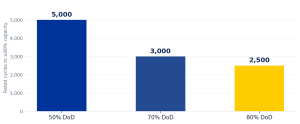
At 80% DoD, that model is rated for 2,500 cycles; at 70% DoD, 3,000; and at 50% DoD, 5,000. A shallower daily cycle can therefore increase the number of cycles before the specified capacity threshold. But total energy delivered over the battery’s life also matters, so the shallowest possible cycle is not always the most economical setting.
Source: Victron Lithium NG 51.2 V technical specifications
Practical advice for Lahore: Set the minimum SoC and backup reserve based on your manufacturer’s guidance and your actual need for evening or load-shedding backup. Do not disable BMS protection or force repeated shutdowns at the low-voltage limit.
2. What is C-rate, and why does it affect battery health?
C-rate describes how quickly a battery is charged or discharged relative to its rated capacity. In simplified power terms for a battery rated at 10 kWh, a discharge of around 5 kW is roughly 0.5C and 10 kW is roughly 1C. This is a nominal DC approximation; actual current, terminal voltage, inverter losses, and the manufacturer’s limits must be considered.
| C-rate | Approx. power from 10 kWh battery | Interpretation |
| 0.2C | 2 kW | Lower power demand |
| 0.5C | 5 kW | Moderate power demand |
| 1C | 10 kW | Higher power demand |
Illustration only. Never infer a battery’s allowed current from kWh alone; check the datasheet and BMS settings.
Higher charge and discharge currents can produce more internal heat and increase electrochemical stress. A battery may support a high peak discharge for a few seconds but a much lower continuous discharge. Manufacturers usually specify charge current, continuous discharge current, short-duration peak current, and temperature-dependent derating separately.
For example, Victron recommends a 0.5C charging current and continuous discharge of no more than 1C for its Lithium Smart range, even though some products permit higher maximum currents. Those are model-family recommendations, not universal rules for every solar battery.
C-rate and hybrid inverter sizing
Suppose a home has a 10 kW hybrid inverter but only one 5.12 kWh battery module. A sudden demand for 7 kW of backup power might exceed the continuous output permitted by that battery or its BMS, even if the inverter itself is capable of supplying the load. The result could be power limiting, a protective shutdown, or accelerated heating if operated outside the recommended range.
That is why the installer must confirm three limits independently: the inverter’s power capacity, the battery bank’s charge/discharge current limits, and the communication settings between the inverter and battery BMS. Additional compatible battery modules may be needed for high overnight loads or multiple air conditioners.
Related MFES guide: Best Hybrid Solar System for Home in Lahore
3. How does temperature affect lithium battery lifespan?
Temperature is especially important in Lahore, where battery rooms can become much hotter than the outdoor weather forecast during summer. Lithium batteries may continue operating in warm conditions, but extended high temperatures can accelerate chemical aging. High current and poor ventilation add further heat.
High temperatures: Heat generally speeds up unwanted side reactions inside lithium-ion cells, reducing available capacity over time. A shaded, dry, ventilated installation area is preferable to direct sunlight or a closed metal enclosure that traps hot air.
Low temperatures: Cold conditions can temporarily lower usable capacity and make charging more restrictive. Some LFP batteries must not be charged below a stated cell-temperature threshold unless they have an approved heating system. The minimum charging temperature is model-specific—not one rule for all lithium batteries.
As a concrete example, Victron’s Lithium NG 51.2 V product specifies charging from +5°C to +50°C and discharging from −20°C to +50°C, with current derating in parts of those ranges. These numbers illustrate why homeowners should check the exact manual rather than relying on a salesperson’s generic “heat-resistant battery” claim.
Further reading: Manufacturer guidance on temperature-dependent operating limits
Practical battery placement in Pakistani homes
- Install according to the manufacturer’s mounting clearances, temperature range, ingress-protection rating, and ventilation instructions.
- Keep batteries away from direct afternoon sun, standing water, and obvious heat sources. Do not assume all batteries can be installed outdoors.
- Monitor cell temperature through the BMS or compatible inverter app when available—not only the room temperature.
- Do not bypass automatic temperature cut-offs or force charging after a BMS fault; ask an authorised technician to investigate.
- Avoid leaving a depleted battery unused for long periods; follow the approved storage SoC and maintenance instructions.
How DoD, C-rate and temperature work together
These factors often reinforce each other. Imagine a home regularly draining its battery to the minimum reserve overnight, then charging it aggressively during a hot afternoon. Deep daily cycling, high charging current, and elevated cell temperature may all increase stress. A battery sized appropriately for the home’s actual kWh consumption and peak kW demand can usually operate with a more comfortable reserve and lower current per module.
For example, a 10 kWh battery used for 7 kWh overnight experiences roughly 70% DoD. If that same battery must supply a 6 kW backup load, it is operating at roughly 0.6C on a nominal DC energy basis. Whether that pattern is acceptable depends on the pack’s continuous current rating, temperature, inverter losses, reserve requirements, and product warranty conditions. Neither example predicts a fixed number of years of life.
What does the Battery Management System (BMS) do?
The BMS monitors and protects the battery by enforcing limits on voltage, current, temperature, and sometimes cell balancing. In a compatible hybrid solar system, BMS-to-inverter communication can tell the inverter when to reduce charging or discharging power. This is a protective function, not a licence to ignore the published operating limits.
When comparing batteries, ask whether the exact battery model is approved for your inverter, which communication protocol is supported, and whether the supplier will commission the system using the current approved firmware and battery profile. Brand names alone are not a substitute for model-level compatibility.
How to extend lithium solar battery life: a 7-point checklist
- Choose storage capacity for daily kWh consumption as well as peak backup kW demand.
- Set minimum SoC / DoD according to the battery datasheet, warranty and required emergency reserve.
- Keep charge and discharge currents within the battery and BMS limits, including temperature derating.
- Install in a dry, shaded, appropriately ventilated location that follows the manufacturer’s mounting guidance.
- Use the correct battery charging profile and manufacturer-approved inverter-to-BMS communication.
- Review alarms, operating temperatures, abnormal shutdowns and capacity trends periodically.
- Follow the manufacturer’s balancing and storage instructions; do not apply generic 80/20 rules blindly.
How to compare two lithium batteries before buying
Do not compare batteries using the headline “10-year life” claim alone. Request the exact datasheet and written warranty, then compare nominal kWh, usable kWh, warranted or rated cycle life at a stated DoD, end-of-life capacity threshold, maximum continuous charge/discharge current, ambient and cell-temperature limits, safety certifications, inverter compatibility, and the manufacturer’s warranty exclusions.
For a Lahore homeowner choosing between a single compact battery and a larger modular bank, the larger solution may make sense if the home has a high evening load or needs longer load-shedding backup. But excess storage can also increase upfront costs without enough daily utilisation. Proper load analysis comes before battery selection.
Frequently asked questions
Does using 100% DoD damage every lithium battery?
No single answer applies to every product. Many lithium solar batteries are designed for deep discharge within their BMS-controlled operating window. However, deeper cycling often reduces the number of cycles to a given capacity threshold. Use the manufacturer’s defined usable capacity, minimum SoC and warranty conditions.
Is 80% DoD better than 100% DoD?
Often, a shallower cycle reduces wear and increases cycle count, but this varies by chemistry and model. It also leaves less energy available per cycle, so the right setting balances backup duration, daily savings, and battery-life expectations.
What does 0.5C mean for a 10 kWh battery?
As a simple approximation, 0.5C means about 5 kW of nominal DC battery power. The precise permitted current depends on the pack’s Ah rating, voltage, continuous-current specification and BMS limits.
Can Lahore summer heat reduce battery life?
Yes. Prolonged heat can accelerate lithium-ion aging. Location, airflow, current draw and actual cell temperature matter; installation should follow the particular battery manufacturer’s requirements.
Can I install a lithium battery outdoors?
Only if the exact battery model and its enclosure are rated for the proposed outdoor environment and the manufacturer permits that installation. Rain protection alone does not address heat, sun exposure, ventilation, or flooding risk.
How many years will a lithium solar battery last?
It depends on chemistry, daily cycling, DoD, C-rate, temperatures, storage conditions, and the manufacturer’s definition of end of life. A cycle-life claim is not automatically a calendar-year guarantee. Review the written warranty alongside the test conditions.
Final thoughts: make battery lifespan part of solar system design
Lithium solar batteries can provide dependable power for years, but longevity is not decided by the brand label alone. Depth of Discharge determines how much energy is used per cycle, C-rate determines how hard the battery is asked to work, and temperature influences both performance and the speed of aging. The best setup balances all three according to an actual load profile and the selected battery’s specifications.
If you are planning a hybrid solar system in Lahore or considering additional battery backup, MFES Solar Energy can help assess your daily energy usage, peak backup loads, battery capacity and inverter compatibility. The goal is a storage system that performs reliably—not simply the highest kWh figure on a quotation.
Explore: MFES residential solar solutions in Lahore
Talk to MFES Solar Energy: Request a solar consultation | Call: +92 300 1599957