
What is BESS? BESS stands for Battery Energy Storage System. It is an engineered system that stores electricity in rechargeable batteries and supplies it later through controlled power-conversion equipment. A complete industrial BESS also includes monitoring, protection, thermal management and operating controls—not just battery cabinets.
For factories and commercial facilities in Pakistan, a BESS can move available energy to a more useful time, manage selected demand peaks or support critical loads when the system is specifically designed for that job. This guide explains the BESS working principle, its essential equipment and what a factory should know before planning an installation.
QUICK ANSWER
A BESS follows four basic actions: charge from an approved electricity source → store energy in battery cells → discharge through a bidirectional power conversion system → control and protect the process through BMS, EMS and electrical safety equipment.
What Is BESS and How Is It Different from a Regular Battery?
A single lithium battery stores energy. An industrial BESS is an integrated installation that makes stored energy usable at a specified power rating, duration and electrical connection point. Battery modules are combined with a Battery Management System (BMS), Power Conversion System (PCS), Energy Management System (EMS), meters, switchgear and site safety controls.
The practical difference is coordination. A BESS can follow operating instructions such as “hold a 20% reserve,” “discharge during an approved peak window” or “stop charging if battery temperature reaches a defined limit.” Those instructions must be supported by the exact equipment, configuration and grid connection.
What Is BESS Used for in a Factory?
Common industrial goals include shifting permitted solar energy into later hours, limiting certain short-duration grid imports and keeping defined priority circuits operating during outages. The project must select one or more objectives before deciding battery capacity or supplier. A factory purchasing storage only by its advertised kWh rating may end up with the wrong AC power output or backup functionality.
How Does BESS Work? The Four Stages of Energy Storage
The answer to how does BESS work becomes easier when the system is followed from the incoming electrical source to the factory load. The sequence below describes a typical AC-connected example; real industrial projects can use different AC- or DC-coupled arrangements.
BESS Working Principle — Four Stages
Solar / approved grid power charges the battery through power-conversion equipment.
Battery cells store energy under BMS and thermal protection.
The PCS provides permitted AC output to facility loads.
EMS, BMS and protection systems supervise every stage.
Conceptual diagram — operating sequences vary by AC/DC coupling and site design.
BESS Working Principle: 1. Charging
Electricity from an approved grid connection, on-site solar system or another permitted source is directed toward the battery. In an AC-coupled design, a bidirectional PCS converts AC electricity into the controlled DC supply used to charge the battery. The BMS communicates permitted charging limits, while the EMS schedules charging according to site needs.
Stage 2: Storing Energy Safely
Battery cells hold energy electrochemically. The BMS tracks measurements such as voltage, current, temperature and state of charge. Cooling or ventilation equipment operates as specified by the manufacturer. Protection devices and the site control system respond to alarms or conditions outside the permitted operating window.
Stage 3: Discharging to the Facility
When the operating plan requests stored power, the battery releases DC electricity. The PCS converts it into controlled AC output for the permitted facility connection. This power can supplement grid imports, meet a scheduled load or serve an approved backup circuit. Actual discharge is limited by PCS power, battery condition, state of charge and site protection settings.
Stage 4: Monitoring and Responding
The EMS decides when and how much to charge or discharge based on programmed priorities. Monitoring systems report energy flows, alarms and performance. If a component reports a fault or reduced allowable output, the controls should follow the engineered safety sequence—not continue dispatching at the original setpoint.
BESS Components: Battery, BMS, PCS, EMS and Protection
A useful introduction to BESS components is to separate the equipment that stores energy from the equipment that converts, supervises and protects it. Exact configurations differ between cabinet, rack and containerized systems.
| Component | What it does |
|---|---|
| Battery modules and racks | Store electricity as chemical energy; rated in kWh or MWh. |
| BMS — Battery Management System | Monitors battery condition and enforces permitted operating limits. |
| PCS — Power Conversion System | Converts between DC battery electricity and AC facility electricity. |
| EMS — Energy Management System | Schedules charging and discharge against operational goals. |
| Thermal management | Keeps cells and equipment within designed temperature limits. |
| Electrical and fire safety | Includes protective switching, isolation, detection and site-specific risk controls. |
| Metering, SCADA and switchgear | Connects, measures and supervises the installation and its electrical network. |
Battery Energy Storage System Explained: How BMS, PCS and EMS Cooperate
Imagine the factory EMS requests 300 kW of discharge to reduce a short demand peak. The BMS first reports the battery’s allowable power at its current temperature and state of charge. The PCS then delivers a permitted AC output—possibly less than 300 kW if a limit applies. This is why a BESS is a coordinated control system, rather than a collection of independent devices.
Manufacturer resources such as ABB’s BESS fundamentals explain how batteries, power conversion and site controls interact.
BESS Capacity Explained: kW, kWh and Operating Duration
One of the most important BESS concepts is the difference between power and energy. kW (or MW) tells you the rate at which the system can deliver electricity. kWh (or MWh) tells you how much energy is stored. Both are needed to assess whether the system can support a particular load.
ILLUSTRATIVE FACTORY EXAMPLE
A facility needs 500 kW for 2 hours. The requested AC energy is 500 × 2 = 1,000 kWh. With an illustrative 90% usable depth of discharge and 95% discharge conversion efficiency, the nominal battery estimate is approximately 1,170 kWh (1,000 ÷ 0.90 ÷ 0.95).
Nominal battery estimate ≈ 1,170 kWh using illustrative DoD and conversion assumptions, before additional engineering margins.
This is an educational example, not a final engineering size or equipment offer. A real system must allow for battery aging, temperature, discharge-rate limits, auxiliaries, safety reserves, motor starting requirements and the PCS’s continuous power rating. A nominal “1 MW / 2 MWh” system similarly indicates approximately two hours at rated power before site-specific losses and operating restrictions.
Industrial BESS in Pakistan: A Practical Factory Example
Consider a hypothetical textile or manufacturing facility in Lahore with rooftop solar, daytime production and a higher late-afternoon load. Its electrical team may study the following operating sequence:
- Daytime: Solar serves the active factory load. If there is eligible surplus energy and the system design allows it, some can charge the BESS.
- Late afternoon: The EMS may discharge stored energy to reduce approved grid imports or meet a selected load as solar output declines.
- Unexpected outage: Only a BESS engineered with suitable backup/islanding controls can power its designated circuits; an ordinary grid-tied arrangement may stop operating.
- After operation: Monitoring data helps the engineer compare actual energy throughput, round-trip losses, state of charge and operating cost.
These steps are examples, not a promise of savings. For industrial BESS in Pakistan, the correct strategy depends on interval meter readings, tariff categories, demand charges, allowed grid arrangements and degradation costs. The IEEFA analysis of battery storage in Pakistan provides wider market context, while each facility still needs its own feasibility study.
Can an Industrial BESS Supply Power During a Grid Outage?
Sometimes—but not automatically. A grid-connected battery can be configured mainly for scheduled energy management. It may shut down when the utility supply fails unless the installed system supports intentional islanding, suitable switching, grid-forming or backup capability, and appropriate protection coordination.
What Is BESS Backup Mode?
Backup mode means a properly designed storage system can energize selected protected loads independently of the unavailable grid, subject to its rated output and stored energy. The engineer must check transfer time, starting currents, reserve state of charge, critical-load segregation, earthing and interconnection approvals. A BESS cannot be treated as a plug-in replacement for every UPS or diesel generator.
The U.S. Department of Energy’s microgrid guidance explains the importance of safe grid separation during islanded operation.
Solar Battery Energy Storage System: How Solar and BESS Work Together
A solar battery energy storage system can increase the use of eligible electricity produced on site by storing some of it for later. How this works depends on whether the batteries are connected on the AC side, through a DC-coupled configuration or as part of a custom microgrid. Controls must coordinate with solar generation, facility demand, export rules and protection systems.
For an existing industrial solar plant, an assessment should examine the present inverter model, connection topology, switchgear, meter arrangement and actual hourly solar output before selecting storage. Larger batteries are not automatically more useful; a properly matched PCS power rating and discharge schedule may matter more to the business case.
MFES also explains its commercial solar solutions for organisations considering solar infrastructure alongside energy-management upgrades.
What Are the Benefits and Limitations of BESS?
An appropriately designed industrial BESS may support more flexible energy use, improved on-site consumption of suitable solar output, managed demand peaks and backup for designated loads. It can also provide performance data for maintenance and operational decisions.
However, a BESS does not generate free electricity, guarantee zero electricity bills or remove all outage risks. It has conversion losses, finite battery life, cooling needs and an upfront capital cost. Financial results depend on a verified tariff, permitted operating strategy, annual throughput and service/warranty conditions.
What Should a Factory Check Before Planning Industrial BESS?
- Define the use case: peak-demand management, solar time shifting, critical-load backup or a hybrid microgrid.
- Collect real data: at least 12 months of electricity bills plus 15-minute or hourly load and solar production records where available.
- Set power and energy requirements separately: kW/MW for output and kWh/MWh for usable energy.
- Validate electrical capability: PCS, BMS/EMS integration, switching, grid permissions, transformer and protection requirements.
- Review safety and lifetime: thermal management, detection, emergency procedures, manufacturer certifications and warranty throughput.
- Model economics honestly: compare tariff-dependent savings against energy losses, degradation, operations and maintenance.
For commercial feasibility, equipment selection and connection design should be completed by qualified engineers using the factory’s actual operating conditions.
Frequently Asked Questions About Battery Energy Storage Systems
Is BESS the Same as a Solar Battery?
No. A solar battery is one storage component. A BESS includes batteries plus coordinated power conversion, monitoring, protection and controls. Some small solar-plus-battery systems are technically energy-storage systems, but industrial installations require a larger engineering scope.
Does BESS Generate Electricity?
No. A battery stores energy from an approved source and later returns some of it. Round-trip losses mean less electricity is recovered than was used to charge it.
Can BESS Run a 500 kW Factory for Two Hours?
Only if the selected system has sufficient continuous AC power, usable stored energy, appropriate discharge limits and supporting electrical design. The illustrative 500 kW / 2-hour load requires 1,000 kWh of delivered AC energy before design margins.
Is an Industrial BESS Better Than a Diesel Generator?
They serve overlapping but different purposes. A BESS can respond quickly and shift previously stored energy; a generator can operate as long as fuel and maintenance conditions allow. Some factories use both. The right comparison depends on outage duration, cost, fuel logistics and required power quality.
Which Battery Chemistry Is Used in Industrial BESS?
Lithium iron phosphate (LFP) is widely used in stationary storage, but chemistry and product selection must consider technical documents, cycle life, temperature limits, system safety features and project economics.
How Much Does Industrial BESS Cost in Pakistan?
There is no reliable universal price per kWh for every project. Cost depends on battery energy, PCS power, thermal/fire protection, civil and electrical works, import costs, warranty and site integration. Request a scope-based engineering proposal.
Conclusion: What Is BESS and Is It Worth Considering for Your Factory?
BESS is a complete energy-storage and control system that charges, stores and dispatches electricity when conditions allow. For an industrial site, the most important question is not simply “How big is the battery?” It is which loads should the storage serve, for how long, and under what permitted electrical arrangement?
If your facility is evaluating a solar-plus-storage or industrial battery project, explore MFES’s industrial solar solutions and discuss the initial technical requirements with our team. Final feasibility, scope and performance depend on a site study and selected equipment.
Contact MFES Solar Energy for an initial engineering discussion.
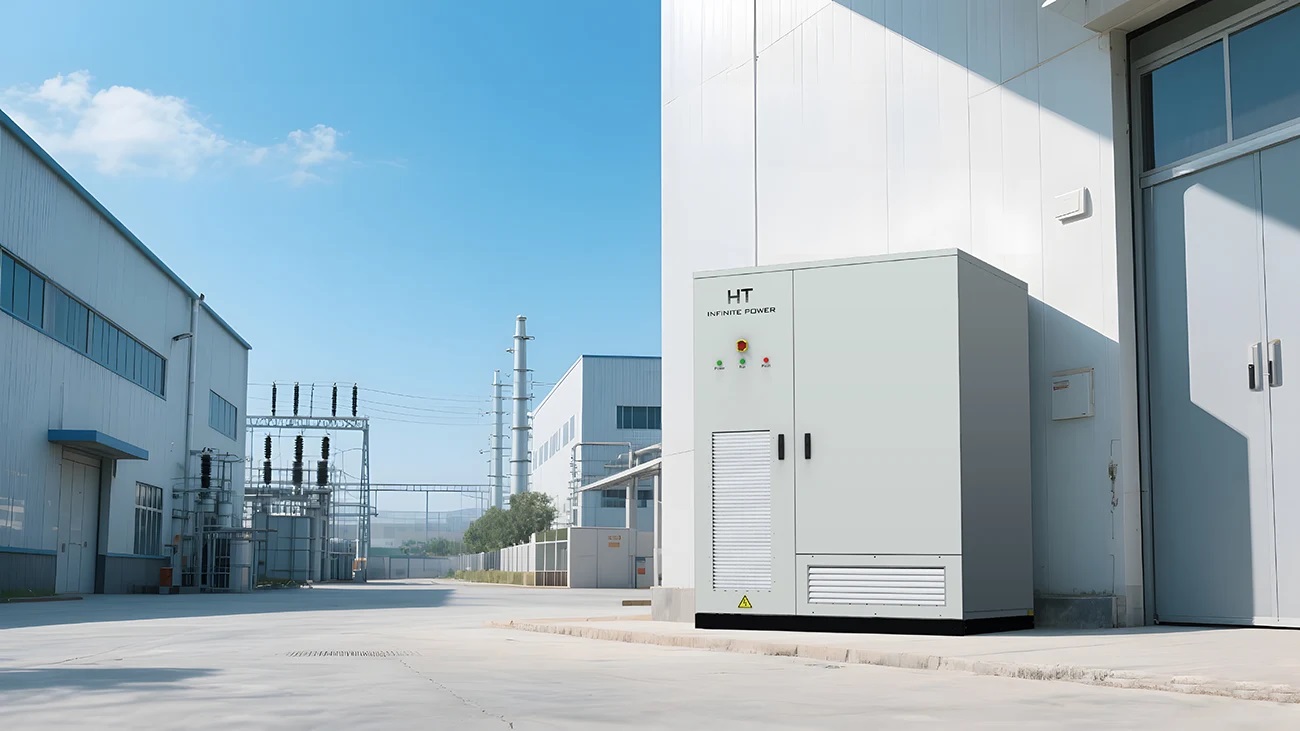
Photo credits: Featured image of Reid Gardner BESS by Sig. Chiocciola and industrial battery cabinet by Yan lance, both licensed CC0 via Wikimedia Commons. Images are illustrative and do not depict MFES installations.
1 comment
BESS Vs Diesel Generator: Which Backup System Is Better For Factories In Pakistan? - MFES Solar Energy
November 21, 2026