
Solar Inverter and Lithium Battery Compatibility: Benefits of Using the Same Brand
Solar inverter and lithium battery compatibility is one of the most important checks when choosing a hybrid solar system for a home or business in Lahore. A premium inverter and a high-capacity lithium battery may look like a perfect combination, but they still need to exchange the right information and operate within the same electrical limits.
That is why many buyers ask whether purchasing an inverter and lithium-ion battery from the same brand is better than combining two different brands. The answer is practical: a same-brand pairing can offer simpler setup, monitoring and technical support, but an officially approved mixed-brand pairing can also perform reliably.
In this guide, MFES Solar Energy explains how battery compatibility works, the benefits of a matched system, the role of BMS communication and what Lahore homeowners should verify before installation.
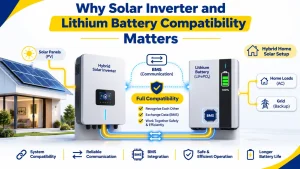
Why Solar Inverter and Lithium Battery Compatibility Matters
An inverter converts and manages electrical power, while the lithium battery stores energy for later use. In a hybrid installation, the inverter may charge the battery from solar or the grid and discharge it to support selected household loads. The battery management system (BMS) supervises the battery and communicates limits that the inverter must respect.
A compatible pair is not simply two products with the same nominal voltage. The inverter must support the battery’s working voltage range, charge/discharge currents, communication protocol, selected battery profile and applicable firmware versions. The manufacturer may also specify approved communication cables and installation settings.
When these details are wrong, the system might fail to detect the battery, show inaccurate state of charge, limit charging or produce a communication alarm. Incompatibility does not necessarily mean equipment damage will occur, but it should be resolved before the system is energized and handed over.
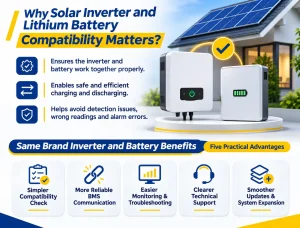
Same Brand Inverter and Battery Benefits: Five Practical Advantages
The strongest same brand inverter and battery benefits relate to integration and service convenience—not to an automatic increase in solar generation. Here are five potential advantages of a correctly approved matched system.
1. Simpler compatibility verification
A manufacturer often publishes tested combinations of its own inverters and batteries in a compatibility list. This makes it easier for an installer to confirm the correct models, firmware and wiring instructions. However, even equipment from one manufacturer may be incompatible across different voltage classes or product generations.
2. More predictable BMS communication
A supported battery can share status and operating limits with the inverter. This helps the inverter respond to the battery’s permitted charging and discharging conditions. A matched manufacturer ecosystem may make protocol selection simpler, provided the exact products are approved to work together.
3. Easier monitoring and fault diagnosis
Some integrated systems allow the customer or installer to view inverter operation alongside battery status through one app or portal. When a fault occurs, it may be easier to inspect battery alarms and inverter events together. Monitoring features are product-specific, so buyers should request a demonstration instead of assuming every same-brand pairing has one dashboard.
4. Clearer technical-support coordination
If the battery and inverter come from one manufacturer, there may be fewer separate support teams involved in diagnosing an integration issue. That can simplify the process, but warranty coverage, response times and installation responsibility remain subject to written terms and the local seller’s support arrangements.
5. Straightforward updates and future expansion
An approved ecosystem may provide clearer firmware guidance and recommended procedures for expanding battery capacity. This is helpful if a household later wants longer backup time. Still, adding battery modules must follow the exact expansion rules, battery generation, age restrictions and maximum parallel-unit limits stated by the manufacturer.
Lithium Battery BMS Communication: How It Works
Lithium battery BMS communication is the information link between the battery management system and the hybrid inverter. Depending on the equipment, the physical connection may use CAN bus or RS485. The two devices must also agree on the correct protocol, communication settings and cable pinout.
In supported managed-battery systems, the BMS can provide data such as state of charge (SoC), temperature or fault status, plus charge-voltage and charge/discharge-current limits. The inverter can then respond according to the supported control method. Exact fields and behavior differ between manufacturers.
For example, Victron Energy documents managed CAN-bus arrangements in which the battery sends charge-voltage, charge-current and discharge-current limits to the system controller. This illustrates why real communication compatibility is more useful than a brand-name match alone.
Manufacturer reference: Victron Energy – DVCC and managed battery communication
Can a Different-Brand Inverter and Lithium Battery Work Together?
Yes. A different-brand combination can be a sensible choice when both manufacturers confirm that the exact models are supported. In fact, GoodWe’s official compatibility overview lists selected third-party battery models—including Dyness and Soluna—alongside its own battery products. This does not approve every Dyness or Soluna model with every GoodWe inverter: only the combinations shown in the relevant list are covered.
The key is to verify the inverter model, battery model, battery voltage class, battery firmware, inverter firmware and communication requirements. A technician should check the current compatibility list for the intended market rather than relying on a reseller’s general claim that two brands “work together”.
Manufacturer reference: GoodWe – Battery Compatibility Overview
Same-Brand vs Approved Different-Brand Battery Systems
| CHECKPOINT | SAME BRAND | APPROVED DIFFERENT BRANDS |
| Model compatibility | Still requires exact-model check | Still requires exact-model check |
| BMS communication | Can be easier to configure | Can work correctly with approved protocol |
| Monitoring | Single-platform options may be available | Depends on specific integration |
| Warranty/support | May simplify coordination | May involve two support channels |
| Battery life | Not guaranteed to be longer | Not inherently shorter |
| Future expansion | Follow approved product rules | Follow approved product rules |
The better choice is the pairing that meets your voltage, power, backup, warranty and service needs with documented compatibility. A shared logo is not proof of performance.
Hybrid Solar Inverter Battery Compatibility Checklist
Before purchasing a lithium battery for a hybrid solar inverter, use this hybrid solar inverter battery compatibility checklist with your installer:
- Write down the complete inverter model, battery model and each product’s exact series or generation.
- Confirm whether both products are low-voltage or high-voltage systems; never assume a 48V-class battery matches a high-voltage inverter.
- Match the manufacturer-approved battery voltage range, maximum charge/discharge current and permitted battery capacity.
- Check the latest approved-battery list for the inverter model and intended market.
- Confirm CAN/RS485 communication mode, supported protocol, cable pin assignment and required battery profile.
- Verify the inverter and battery firmware versions, and update them only as instructed.
- Read both warranty policies and ask who handles integration-related support in Pakistan.
- Request a commissioning test showing SoC, charge/discharge operation, any battery alarms and backup behavior.
A professional installer should handle electrical connections and configuration. Do not experiment with battery communication cables, DC wiring or settings without manufacturer-approved guidance.
Real-World Example: GoodWe Hybrid Inverter and Lithium Battery
Consider a Lahore homeowner selecting a GoodWe hybrid inverter. One possible route is to choose a compatible GoodWe Lynx battery listed for the specific inverter series. Another route may be to use a third-party battery model listed in GoodWe’s published compatibility overview. Both options require verification of the actual model numbers and any firmware notes.
This is not a claim that every GoodWe battery fits every GoodWe inverter, nor that all third-party batteries are approved. GoodWe’s documentation lists supported combinations separately for low-voltage and high-voltage energy-storage systems, with additional notes for certain models. The buyer should obtain an equipment schedule showing the exact pairing before paying.
For system options and typical components, see the MFES guide to hybrid solar systems in Lahore.
Related MFES guide: Best Hybrid Solar System for Home in Lahore (2026)
Lithium Battery Inverter Compatibility in Pakistan: What Lahore Homeowners Should Check
Lithium battery inverter compatibility in Pakistan matters especially when customers are buying imported products through different distributors. The warranty provider, model revision and available technical support may differ even when the brand names are familiar.
For Lahore homes, planning should include the load that must run during an outage, the expected backup duration, space and ventilation for the battery, and seasonal temperatures. The battery should be installed only in a location that meets the manufacturer’s thermal and environmental specifications. In summer, avoid placing equipment in unventilated spaces exposed to direct heat.
Battery size and inverter rating are separate decisions. A larger battery can increase stored energy, but it does not automatically raise the inverter’s AC output or the battery’s allowable peak discharge power. Ask the installer to calculate both energy capacity (kWh) and supported power (kW).
If you are planning a new installation, MFES also provides a residential solar guide covering on-grid, hybrid and off-grid options.
Related MFES service guide: Solar for Homes in Lahore
Common Mistakes When Pairing a Hybrid Inverter and Battery
- Assuming “48V battery” means every low-voltage inverter will accept it.
- Checking the brand but not the exact battery and inverter model numbers.
- Ignoring BMS protocol, required cable wiring or firmware notes.
- Choosing a battery by kWh alone without checking allowable charge/discharge power.
- Assuming same-brand products automatically share a single warranty.
- Buying extra battery modules before checking expansion limits and generation compatibility.
Avoiding these mistakes can protect installation quality and reduce unnecessary troubleshooting. It also makes it easier to choose a system that matches the household’s real backup and budget requirements.
FAQs About Solar Inverter and Lithium Battery Compatibility
1. Is it better to buy an inverter and lithium battery from the same brand?
It can be more convenient for setup, monitoring and support when the exact models are approved. However, an officially compatible cross-brand pairing can be equally suitable for many installations.
2. Does a same-brand inverter increase lithium battery lifespan?
Not automatically. Battery aging depends on cell chemistry, temperature, depth of discharge, charge/discharge conditions and operating limits. Correct compatibility helps the system respect supported limits, but does not guarantee extra years of life.
3. Can I use a Dyness or Soluna battery with a GoodWe inverter?
Some specific models appear in GoodWe’s compatibility documentation. You must check the exact inverter series, battery model and firmware requirements against the current manufacturer list; the brand names alone are not enough.
4. What happens if BMS communication fails?
Depending on the inverter and battery, the system may stop charging or discharging, restrict operation or display a communication fault. The installer should follow official troubleshooting procedures and verify the cable, protocol, profile and firmware.
5. Can I add more lithium batteries later?
Possibly, if the manufacturer permits the exact module and quantity. Parallel operation, battery generation, firmware and permitted expansion limits should be confirmed before buying extra units.
6. What matters most when buying a hybrid solar system in Lahore?
Choose a properly sized inverter, a battery with sufficient usable energy and discharge power, documented inverter-battery compatibility, safe installation and reliable local warranty support.
Conclusion: Choose Verified Compatibility, Not Just a Matching Logo
Solar inverter and lithium battery compatibility should be confirmed before the equipment is purchased—not after installation. Buying the inverter and battery from the same brand can make integration and support simpler, but the real test is whether the exact products are approved and configured to work together.
MFES Solar Energy helps Lahore homeowners compare hybrid solar system options based on their loads, desired backup time and equipment specifications. If you are selecting an inverter and lithium battery, ask for an exact-model compatibility check before finalizing your system.
Talk to MFES Solar Energy: Request a solar consultation | Call / WhatsApp: +92 300 1599957