LESCO Fixed Charges 2026: Why You Still Get a Bill After Installing Solar
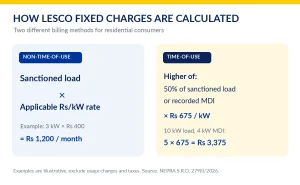
Quick answer: Solar panels can reduce the electricity you buy from LESCO, but they do not automatically remove fixed charges while your home remains connected to the grid. In Pakistan’s February 2026 residential tariff, most non-lifeline categories carry a fixed charge calculated using sanctioned load or, for time-of-use (TOU) customers, a specified billing-demand formula. The amount depends on your connection and tariff category—not simply on how many solar panels you have.
Have you installed a solar system in Lahore but still receive a monthly LESCO bill? You are not alone. The reason may include fixed charges, electricity imported after sunset, taxes, adjustments or the way exported solar power is credited. Understanding each item is the first step to lowering your bill without unrealistic “zero-bill” promises.
This guide explains the difference between capacity payments and LESCO fixed charges, shows the 2026 tariff-based calculations and outlines when on-grid or hybrid solar can help.
What are capacity charges in Pakistan?
In Pakistan’s electricity sector, capacity payments generally refer to costs of maintaining contracted electricity-generation capacity available under power-purchase arrangements. Some payments can arise even when plants do not generate their maximum possible energy. They are part of a wider set of costs that regulators and tariff setters must recover across the power system.
That helps explain why bills include more than the cost of the electricity actually consumed. However, it would be misleading to call every fixed charge on a household bill a direct “capacity payment to an IPP.” Generation-capacity costs and a consumer’s fixed-charge tariff are related but different.
NEPRA’s February 2026 tariff decision explicitly discussed recovering a greater share of fixed power-sector costs through fixed charges, in light of changing grid electricity consumption and growing rooftop solar adoption. See the official NEPRA tariff decision.
Why do I still receive a LESCO bill after installing solar?
Most solar-connected homes remain linked to LESCO for electricity when solar output is low, after sunset or when demand exceeds generation. Even a well-sized system may leave some grid imports and charges on the monthly bill.
- Fixed charges: These may apply according to your sanctioned load, current tariff slab or recorded MDI, as explained above.
- Imported grid units: You pay for electricity taken from LESCO when solar and stored energy do not meet the load.
- Bill adjustments and taxes: Depending on tariff and bill conditions, items may include fuel-cost adjustments, quarterly adjustments, taxes and duties.
- Solar export credits: Under the applicable prosumer agreement, exported energy may generate a credit, but credits are not the same as removing fixed charges from the tariff.
To understand how imported and exported electricity are treated, see our separate guide on how net billing works in Pakistan. Existing solar customers should confirm which agreement and billing rules apply to their individual connections; do not assume every legacy contract has identical terms.
Can on-grid solar eliminate LESCO fixed charges?
Usually not while the LESCO connection remains active. An on-grid system produces electricity mainly during daylight hours and reduces the units bought from the grid. It may lower your energy charges substantially, but it does not automatically cancel the applicable fixed-charge line.
For a household that uses little electricity after solar installation, the remaining bill can feel surprising. The crucial question is whether the remaining amount comes from fixed charges, imports, adjustments or a mixture of these—not whether the panels are malfunctioning.
Can hybrid solar with batteries remove the charges?
A hybrid solar system can store energy for evening use and offer backup during outages when configured correctly. This can further reduce imported grid units and improve self-consumption, particularly when export and import electricity have different monetary values.
But a battery is not a legal exemption from LESCO fixed charges. If your grid connection stays active, the connection’s applicable tariff and billing rules still matter. Read our comparison of hybrid solar systems for Lahore homes for the practical benefits and limitations.
A genuinely off-grid property with no active LESCO supply has a different cost structure, but it must be designed for seasonal demand, battery reserve and backup reliability. Disconnecting a grid service should never be undertaken solely to avoid fixed charges without evaluating safety, legality and total lifetime costs.
How can Lahore homeowners reduce their electricity bills?
There is no universal “zero fixed charges” trick. The better approach is to use your bills, meter data and actual home loads to reduce avoidable grid purchases and understand every charge.
- Check your approved sanctioned load. If it is unusually high for your property’s legitimate requirements, ask LESCO about the official process and implications of a load revision. Never bypass meters or reduce approved capacity below safe demand.
- Read the full bill, not only payable amount. Find tariff class, sanctioned load, MDI (if applicable), imported units, exported units, adjustments and the fixed-charge entry.
- Increase daytime self-consumption where practical. Scheduling water pumps, laundry and other suitable loads when solar generation is available may help use more of your own output.
- Consider battery storage on evidence, not hype. Compare night-time consumption with usable battery capacity, inverter compatibility, budget and expected savings.
- Keep the system performing. Monitor inverter production, shade, fault alerts and panel cleanliness; investigate sudden declines before assuming every bill increase is a tariff issue.
- Avoid oversizing based only on exports. Match your new or expanded system to actual load patterns, network permissions and the billing arrangement.
If you are planning a new system, our guide to solar for homes in Lahore explains options for on-grid, hybrid and residential installations.
How to check the fixed charge on your own LESCO bill
Before requesting a new inverter or battery quotation, take your latest two or three bills and complete this simple review:
- Confirm whether your meter is non-TOU or TOU, plus your residential tariff category.
- Locate sanctioned load in kW; for TOU customers, also look for MDI.
- Record imported units and, if relevant, exported units/credits for the period.
- Check the fixed charge line and compare it with the notified formula for that connection.
- Separate energy charges and fixed charges from taxes and adjustments before comparing solar savings.
For privacy, never post an uncensored bill online. Hide your reference number, account details, address and any identifying information before sharing a bill for review.
Is solar still worth installing in Lahore in 2026?
Solar can still deliver meaningful savings by reducing the electricity you purchase from LESCO. But the savings depend on your daytime load, system design, roof conditions, inverter and battery choices, tariffs, and how imported and exported electricity are billed. No responsible installer can promise that every future monthly LESCO bill will be zero.
For a Lahore homeowner, the right decision is based on a 12-month consumption history and a realistic generation-versus-usage model. This is especially relevant in DHA, Johar Town, Wapda Town, Bahria Town and other areas with substantial daytime cooling demand.
A solar investment should be measured against total payable bills over time, not a single good month with high generation. That is why MFES Solar Energy recommends reviewing the existing connection, consumption pattern and expected self-consumption before finalizing the system size.
Frequently asked questions
1. Does LESCO charge fixed fees if my solar produces more units than my home uses?
It can. Solar generation alone does not cancel the fixed-charge rules for an active grid connection. The applicable charge depends on tariff category and billing basis.
2. Are capacity payments displayed separately on every LESCO bill?
Not necessarily. Capacity payments are part of system-level power costs. A household may see fixed charges and other tariff adjustments, but these should not all be relabeled as individual “capacity payment” items.
3. Do fixed charges apply if my imported electricity is zero?
An active, eligible connection may still have fixed charges even if imported units are zero or very low. Life-line exemptions and the exact bill treatment depend on your tariff class and applicable rules.
4. What is the difference between sanctioned load and solar system size?
Sanctioned load is the approved electricity load of your LESCO connection. Solar system size is your panels’ or inverter’s rated capacity. They are different specifications.
5. Can a lithium battery remove my fixed charges?
A lithium battery can reduce night-time grid imports, but it does not automatically exempt a connected consumer from fixed charges.
6. Where can I confirm the latest LESCO tariff?
Check the NEPRA LESCO tariff notifications and the tariff category shown on your actual bill. Tariffs can be updated after publication.
Final verdict: solar reduces your dependence, not every bill component
The practical answer is simple: capacity payments are not identical to LESCO fixed charges, and solar does not automatically remove fixed charges. What solar does well is reduce grid-energy purchases. Smart sizing, better self-consumption and optional storage can improve that result—but the relevant LESCO rules still apply.
Want to know what is keeping your LESCO bill high? MFES Solar Energy can review your electricity usage, existing system and expected solar performance, then suggest appropriate on-grid or hybrid options. Request an MFES solar assessment or call 0300-1599957. MFES Solar Energy is based near Expo Center, Johar Town, Lahore.
Tariff note (updated 27 October 2026): Figures in this article are based on the February 2026 notified residential tariff. Bill treatment can vary by consumer category and subsequent notification. This article provides general information; your actual LESCO bill and current NEPRA notification govern.